
Can Your Faith Be Part of Your Healing? A Look at Christian CBT
Let me be honest with you about something I discovered early in my counseling career that changed everything.
After 10 years working in the field of addictions, I almost walked away from psychology entirely. I had given my life to Christ, and I kept running into this wall where the counseling world was saying, don’t mix religion and therapy. And I remember thinking, “That is the strangest thing I have ever heard. God created us. He knows our psychology better than any psychologist ever will. So why would we leave him out of the room?”
But here is what God revealed to me: a lot of counseling techniques actually came from the Bible. Psychology didn’t invent them. They just ripped God off of them. The most famous example? The 12 Steps of AA were originally the 10 Principles of Salvation taken straight from the Puritan church. They kept a vague “higher power” and removed God entirely.
That’s when I knew my calling wasn’t to leave counseling. It was to bring God back into it.
So when people ask me about Christian Cognitive Behavioral Therapy – yes, it’s real, effective, and honestly, it’s the way counseling was always meant to work.

First, Let’s Talk About What CBT Actually Is
The simple foundational truth about Cognitive Behavioral Therapy is that your thoughts, feelings, and behaviors are all connected. Change one, and the others start to shift too.
That’s it. That’s the whole foundation.
CBT (Cognitive Behavioral Therapy) helps you identify the negative, distorted thought patterns that are running your life, the ones that tell you you’re not enough, that things will never get better, that you can’t trust anyone. Then it gives you tools to challenge those thoughts and replace them with healthier ones.
I used CBT for years. It worked mostly. But here’s what I always noticed: it was missing something. Something enormous.
When you challenge a negative thought with only logic, you might feel better for a little while. But when you challenge a negative thought with the truth of God’s Word? That is a completely different experience. It’s where true transformation happens.
What Makes It Christian CBT?
Christian CBT is not a separate therapy. It is CBT with God fully in the room.
Instead of just replacing a negative thought with a more positive or neutral one, we replace it with biblical truth. And that matters more than you might realize, because here is what I have learned after nearly 30 years of counseling: most of the lies we believe about ourselves are not just psychological problems. They are spiritual ones.
The enemy is not subtle. He has been whispering in your ear since you were a child, “You are not worthy, you are not loved, you are too broken, God couldn’t possibly want you.” Those are not random thought patterns. Those are targeted attacks on your identity in Christ.
And you cannot fully defeat a spiritual attack with just logic. You need the Word of God as your sword.
Paul Said It First
Before there was CBT, there was Romans 12:2.
“Do not conform to the pattern of this world, but be transformed by the renewing of your mind.”
Paul didn’t say, “Think more positively.” He said, “Be transformed.” And that transformation happens through the renewing of your mind.
CBT helps you identify old thought patterns and replace them with new ones. Paul words it a bit differently, he says, “Put off the old self and put on the new.” Ephesians 4:22-24. It’s a similar concept, but the difference with Christian CBT is that we are not just replacing bad thoughts with better thoughts. We are replacing lies with truth, specifically, the truth of who God says you are.
How It Actually Works
Here is how I walk people through this in a very practical way.
Step one: Identify the thought.
Not the feeling. The thought underneath the feeling. When you feel anxious, what are you actually thinking? When you feel worthless, what is the narrative running in your head? We have to name it. You cannot fight something you cannot see.
Step two: Ask whose voice that is.
This is where Christian CBT goes deeper than traditional therapy. I teach people to ask, “Is this thought coming from God, from myself, or from the enemy?” Because there are two voices constantly speaking into our lives. One brings truth, peace, and clarity. The other brings chaos, shame, and confusion. Anything causing confusion and chaos is not from God. That is a clean and simple way to start discerning.
Step three: Replace the lie with truth.
Not just a positive affirmation, but a specific, biblical truth. If you struggle with feeling unworthy, you go to Psalm 139:14. “I am fearfully and wonderfully made.” If you are drowning in shame, you go to Romans 8:1. “There is therefore now no condemnation for those who are in Christ Jesus.” If anxiety is stealing your peace, go to Philippians 4:6-7. You bring everything before God in prayer and thanksgiving, everything, the good and the hard, and then he gives you a peace that makes absolutely no logical sense. That is not your peace. That is His.
Step four: Take the thought captive and speak it out loud.
2 Corinthians 10:5 says to take every thought captive. That is an action. It is not passive. You have to actively say, no, I am not receiving that thought. In the name of Jesus. Out loud. The enemy cannot hear your thoughts, but he can hear a whisper. So whisper it if you have to. But speak it.
This Is Not About Feelings. It Is About Faith.
Here is something I tell my clients regularly, and I will tell you too: faith is not a feeling. It is a choice.
I have a little triangle I use: thoughts, behaviors, and emotions. Most people come to me sitting deep in their feelings, and they want the feelings to go away. I have to explain that our feelings follow the thoughts and choices we make. It will feel strange at first, but if you start to act like you believe something, even when you do not feel it yet, the feelings will catch up.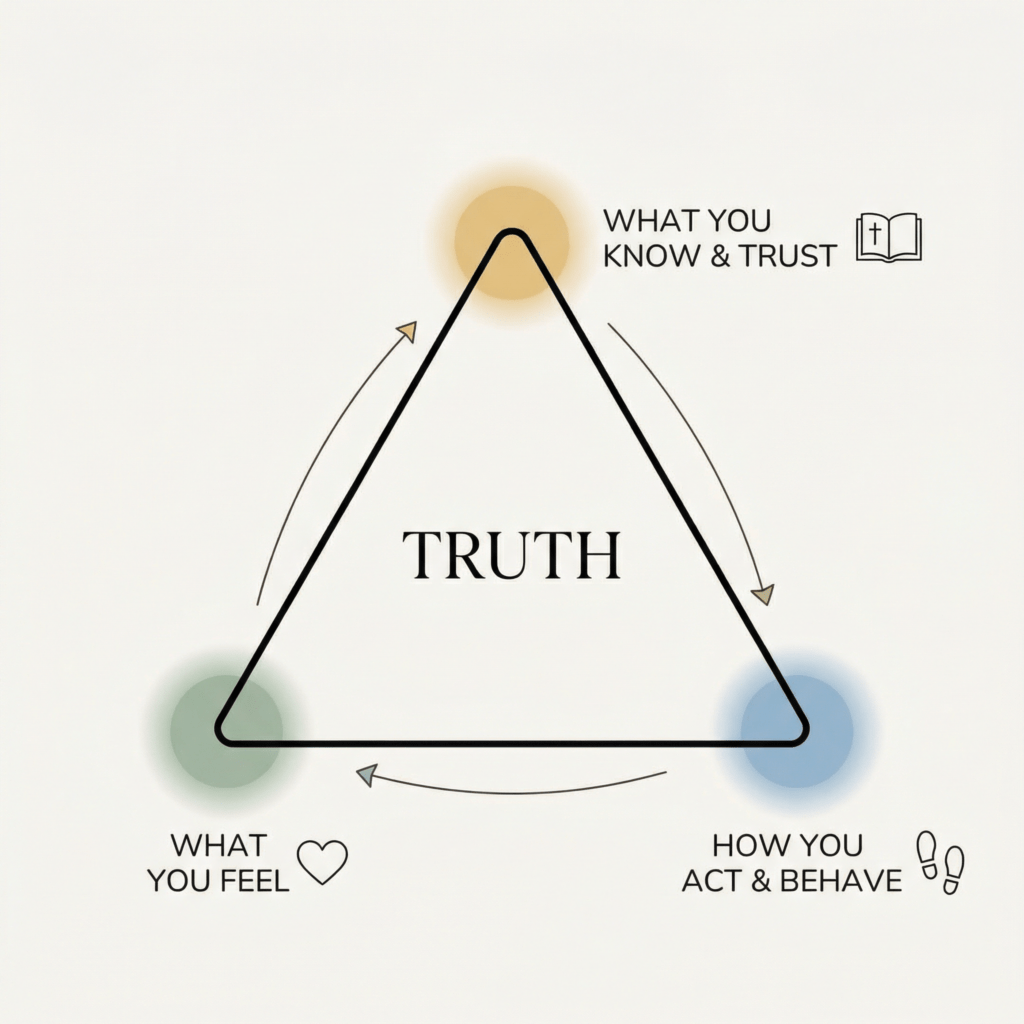
I compare it to going to work. Are there mornings you do not feel like going? Of course! But you identify yourself as employed, so you do what employed people do. You go. You do not sit in the feeling of not wanting to go. You choose to go anyway.
Now, let’s introduce God into our situation. As a christian saved by the blood, you need to identify yourself as a child of God, such as “I am the daughter or son of the King”, then you act on those thoughts and words. Even when you do not feel it. Especially when you do not feel it. Because that’s where faith actually lives. Not in the mountain-top moments. In the moments where you choose him anyway.
Replacing Old Thoughts and Behaviors
Just as Paul encourages believers to transform their minds by aligning them with God’s truth, Christian CBT helps you replace unhealthy, worldly thinking with Scripture-based thinking. For example, if you struggle with negative self-talk and believe you are unworthy, Christian CBT will guide you to replace those thoughts with God’s truth, such as Psalm 139:14, which affirms, “I am fearfully and wonderfully made.”
Who Can Christian CBT Help?
In my experience, almost anyone who wants to grow can benefit from this approach. But I have found it is especially powerful for:
Anxiety and worry. Anxiety is almost always living in the future. It’s the “what ifs” and the worst-case scenarios. Christian CBT brings you back to the present and back to the character of God. He is not surprised by what you are facing. He is already in your tomorrow. Zephaniah 3:17 says the Lord your God is in your midst. He is with you right now.
Depression. Depression tends to live in the past. In regret, grief, and in things that cannot be changed. Christian CBT doesn’t ignore the pain. But it helps you find God in it. He is near to the brokenhearted. He collects your tears in a bottle. He does not waste your suffering.
Negative self-talk and shame. This is probably the thing I work on most with people. The lies about who you are. Shame is one of the most effective tools the enemy uses, and it runs deep. But when you truly begin to grasp your identity in Christ, not just intellectually, but in your bones, shame loses its grip. You are not defined by what happened to you. You are not defined by your worst moments. You are defined by who God says you are.
Breaking unhealthy patterns. Whether it is people pleasing, overeating, compulsive behaviors, or destructive relationships, these things are almost always connected to a deeper wound. An unmet need. A trauma response. Christian CBT helps you trace it back to the root and invite God into the healing, not just manage the symptoms.
One More Thing I Want You to Know
Psychology does not have to be the enemy of faith. And faith does not have to check itself at the door of a counseling office. For nearly 30 years, I have been reconciling the two, and I can tell you with complete confidence that when you bring God into the counseling room, something shifts that no purely clinical approach can replicate.
You were not created to white-knuckle your way through life. You were created for peace. Not the happiness the world sells you. Not the absence of hard things. But the kind of deep, settled peace that Philippians 4 talks about is the peace that surpasses all understanding. The peace that comes from holding the hand of the One who is already in your past, your present, and your future.
That peace is available to you. And I would love to help you find your way there.
Contact Jane Perkins today to schedule a free 20-minute consultation and begin your healing journey through Christian CBT.
Christian Cognitive Behavioral Therapy is a genuine and effective approach to overcoming mental health challenges while remaining faithful to biblical teachings. It offers a holistic way to address your mind, body, and spirit, enabling you to experience the transformation and healing that God desires for your life.
Articles on Depression and Mental Health
Walking through Grief God’s Way
